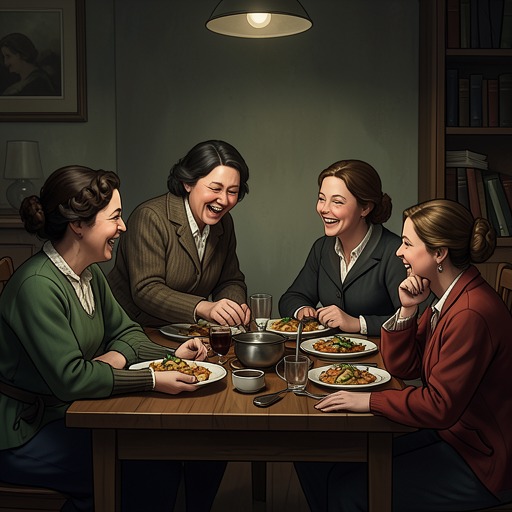
Bridget Jones–Talitha friendship
Bridget Jones: Mad About the BoyThe friendship between Bridget Jones and Talitha is one of the practical supports through which Bridget Jones begins to imagine a life beyond bereavement and single motherhood. Their history predates the events of the novel: Talitha was a glamorous newsreader and Bridget Jones an incompetent reporter in their Sit Up Britain days. In the present, Talitha turns that old closeness into action. She invites Bridget Jones into her social life, urges her to recover her sexual confidence, and actively intervenes in her dating prospects. Her help can be tender and perceptive, but it can also cross into matchmaking conducted on Bridget Jones’s behalf.
A Long Friendship and a Public Birthday
Talitha’s sixtieth birthday gives the friendship a particularly revealing test. She tells Bridget Jones that the party will be on 24 May, while insisting that the milestone is not to be announced and that she is not inviting everyone. The confidential, dramatic manner of the invitation is characteristic of Talitha, but its insistence is unmistakable: Bridget Jones must come. The invitation is not merely a social obligation. Bridget Jones has been her friend since their shared television days, and Talitha expects her to be present for an important occasion.
Bridget Jones weighs whether to take Roxster to the party. Bringing him would let her resist the pity directed at single women of a certain age and would make the age contrast between the birthday woman and her younger partner visible. At the same time, she fears that the setting might make Roxster uncomfortable or expose her own anxieties about their age difference. The calculation reveals how closely Bridget Jones’s private relationship has become entangled with public ideas about age and desirability. Talitha’s party is the occasion around which those worries gather, even though Talitha herself is not responsible for creating them.
Talitha’s Campaign to Restore Bridget’s Confidence
Talitha’s encouragement predates the Roxster relationship. At a semi-regular evening at Shoreditch House, she scans the room for possible sexual partners for Bridget Jones and insists that Bridget Jones needs to have sex. Tom joins in the effort to get her out of the house. Their intervention is affectionate, but the episode also shows the friends treating Bridget Jones’s re-entry into social life as something that requires a concerted push.
Talitha makes her view of the problem explicit: in her judgment, Bridget Jones has misplaced her sexual self, and her friends have a duty to help her find it. She pairs this diagnosis with a more theatrical belief that looking younger depends on changing the body’s supposed signs of age. Her talk is not simply consolation; it brings the pressures of appearance and ageing directly into the friends’ attempts to help. Bridget Jones and the others respond in silence, sipping their cocktails, a small counterpoint to Talitha’s expansive certainty.
When a prospective date’s silence sends Bridget Jones into a late-night panic, Talitha again arrives in person. Bridget Jones calls her, and Talitha comes over. She reframes the crisis: a man Bridget Jones has met only briefly has not yet texted, but the deeper blow is that Bridget Jones had allowed herself to hope and now feels that possibility slipping away. Rather than endorse Bridget Jones’s old rule never to pursue a man, Talitha argues that dating has changed since their single years and that a woman may need to encourage a man to respond. Her advice is both generational and practical, grounded in the difference between a world of telephone calls and one of texts and email.
Matchmaking, Intervention, and Its Limits
Talitha’s help becomes more intrusive when she reveals that, after exchanging Bridget Jones’s number with the man, she discreetly told him that Bridget Jones was widowed. Bridget Jones is startled that Talitha disclosed this without asking her. Talitha presents widowhood as more romantic and original than divorce, but her explanation does not erase the breach: she has chosen how to frame Bridget Jones’s personal history to a prospective date. The scene captures the friendship’s tension between care and control. Talitha wants to make the encounter more likely to succeed, yet she does so by taking possession of information that belongs to Bridget Jones.
When the man’s text arrives, Talitha encourages Bridget Jones to be brave and return to dating, including for the sake of the children upstairs. Bridget Jones later acknowledges that Talitha was right to push her, even though the encounter with Leatherjacketman goes disastrously wrong. Talitha does not pretend the first date after a long relationship should have been easy. In the aftermath, she accepts responsibility for failing to warn Bridget Jones that the first experience is often the worst, because too much hope becomes invested in it. She also identifies the false burden Bridget Jones had placed on the date: treating a new man as a rescuer and as a measure of whether she remained desirable. Talitha’s counsel does not prevent disappointment, but it gives Bridget Jones a way to understand why the disappointment felt so large.
A Continuing Social and Romantic Link
Talitha’s role extends beyond the first disastrous date. Roxby McDuff, who uses the name Roxster, says that he works for an environmental charity, met Talitha on her show, and followed the route from Talitha’s Twitter account to Bridget Jones’s. Their connection therefore grows through Talitha’s public and social orbit as well as through the private introductions she makes. Roxster’s stated preference for older women challenges Bridget Jones’s fear that their age difference makes her an embarrassing exception, although the text does not make Talitha the author of that preference.
The friendship remains part of Bridget Jones’s romantic life after she and Roxster have been together for eleven weeks. When they reconnect following a breakup, Talitha warns against taking back someone who has ended the relationship. Bridget Jones notes this warning alongside Tom’s concern that Roxster may offer messages and sex without a dependable future. The cautions show that Talitha’s involvement is not limited to getting Bridget Jones paired off: she continues to judge the risks once the relationship exists. Bridget Jones nevertheless resumes contact and describes Roxster as kind and cheerful. Talitha’s advice is therefore one influence among several, not a decision imposed on Bridget Jones.
Across these episodes, the friendship moves between companionship, frank counsel and boundary-crossing intervention. Talitha makes herself available when Bridget Jones is overwhelmed, helps her re-enter the world of dating, and links her to the social network through which she meets Roxster. At the same time, her certainty can outrun Bridget Jones’s consent, especially when she shares private information or treats sexual confidence as a problem to be fixed. The relationship matters because it makes Bridget Jones’s return to intimacy collective rather than solitary: her friends encourage and sometimes pressure her, while the choices and consequences remain her own.